
kahkiyaw kita ahtamskatinawaw – I greet you all in a good way.
(long-read alert, long-read alert)
A number of Indigenous people have approached me with the same puzzled look on their faces “who do I vote for in this election?”
It’s a complicated question and without telling anybody exactly who to vote for, my first question is inevitably, “where do you live?” followed by a quick overview of what the electoral cards look like in their riding. In this election, in my opinion as an Indigenous person, voting will be more important than ever.
Indigenous voters are not very fond of the Conservatives. And Indigenous voters are also not very fond of hypocrisy.
Saskatchewan becomes tricky with those 2 points in mind. As it looks right now, a whole bunch of things must be factored into the equation to make an informed guesstimate of how the election will unfold on October 21st.
Here are some of the things to consider:
Polls:
Federal politicians are quick to say they don’t look at polls, and that the only poll that matters “is the one on election day”. And that’s true. Watching the polls these last couple months, and as you can see below, we have not seen any significant shift in the mood of Canadians. Here’s some polling averages over the last 2 months from CBC’s Poll Tracker:
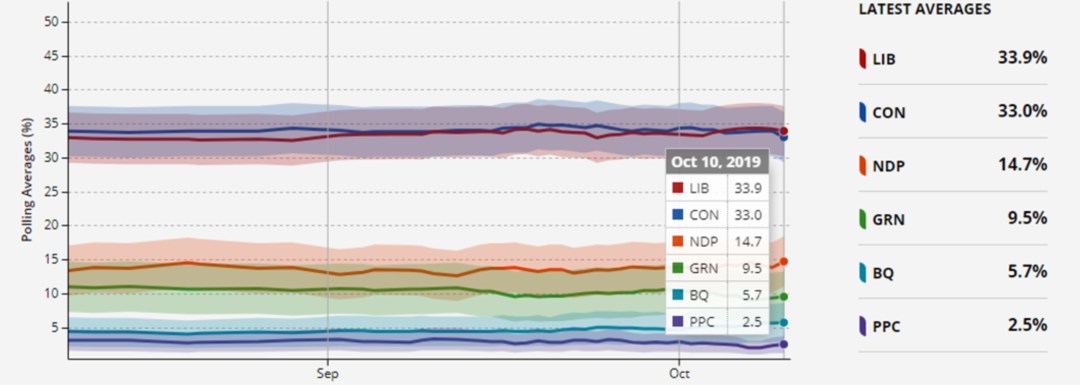
Here’s an overview to date of some of the election considerations as it pertains to the 3 main federal parties.
The Liberals:
Among Indigenous voters, the Liberals have traditionally held strong and consistent support. In the last election, the Indigenous vote was successful in electing 7 Indigenous Liberal MPs – the most in history! That support has waned significantly over the last year due to a number of situations – most specifically Jody Wilson-Raybould being ejected from the Liberal caucus. Barring any other significant embarrassing incidents, it looks as though the Liberals may secure a minority government. The ‘black-face’ incident with the Leader Justin Trudeau certainly had an impact on the party’s electoral outlook and has kept the party from making significant gains nationally. According to polling data, the Liberal Party will likely secure enough seats to form a minority government.
The Conservatives:
Among Indigenous voters, the Conservatives have rarely been a serious consideration, especially after the Harper years. Andrew Sheer likes to tout that his government will work with First Nations people, but CBC had this to say: “some First Nation leaders say he has done little as an MP to build ties with reserves in his own riding of Regina-Qu’Appelle“. How can the leader of the Conservative Party of Canada credibly build relations with Indigenous peoples across the country if he barely has a relationship with the 12 First Nations in his own riding? Hypocrisy. Oh and I forgot, he has dual Canadian-American citizenship. While this is not inherently a bad thing, my question is this: will he be taking the American Pledge of Allegiance, or swearing to uphold the Canadian Charter of Rights and Freedoms? As it stands now, the Conservatives are on the brink of overtaking the Liberal Party to potentially secure a minority government. I’ll detail later how the Indigenous vote can have a significant impact on Conservative electoral outcomes in Saskatchewan.
The NDP:
Among Indigenous voters, the NDP have traditionally held considerable and consistent support. As it stands now, the NDP is enjoying a high in public support. NDP Leader Jagmeet Singh’s recent debate performance (and that gorgeous hair) has boosted his popularity and that of his party, but has not been able to capture enough of the public’s imagination to translate that popularity into a seat boost. Their polling numbers and popular support have stayed relatively low, but stable – around the 15% range. With less than a week left in the federal election, all of that has come too little, too late. However, with a likely Liberal minority government, and NDP Leader Jagmeet Singh’s recent proclamation that the NDP will work with like-minded parties to stop the Conservatives, the NDP could play a HUGE role in policy and government decision making. A potential Liberal minority government will look for allies in the House of Commons and the NDP will be the most likely choice.
But back to Saskatchewan.
Indigenous voters have HUGE opportunity to do some very unique things in this province. I’d like to outline just a few of those opportunities.
In the last federal election, 61.5% of eligible on-reserve Indigenous voters cast a ballot – that’s the highest rate ever!
In this election, Indigenous voters literally have the opportunity to unseat the leader of the Conservative Party of Canada. Here are some thoughts and ideas on what can play out in some of the key Saskatchewan federal electoral districts:
1) Desnethe-Missinippi Churchill River (DMCR)
This is the third largest riding in Canada and has one of the highest Indigenous populations – 71% identify as Indigenous. This sprawling Northern riding has been a back and forth contest between the three main federal parties. The current MP represents the NDP, Georgina Jollibois; the former MP, Rob Clarke, represented the Conservative Party; previous to that, the seat was held by Liberal MP Gary Merasty.
Many are speculating that the opportunity exists to keep the seat progressive either with the re-election of the NDPs Georgina Jollibois, or give the Liberals a second Saskatchewan voice in government with a win by Liberal candidate, and Lac La Ronge Indian Band Chief, Tammy Cook-Searson. The 2015 election was very close: the NDP secured 10,319 votes, with the Liberals trailing with 10,237 votes. With polling indicating what it is, the question in this riding inevitibly becomes:
“Do constituents want a seat in opposition with the NDP, or want a voice in government with the Liberals.”
My thoughts – Liberal. I want to see continued Indigenous, female representation in this riding, but would prefer that voice be in government and not in opposition, I’m throwing my support behind Chief Tammy Cook-Searson and the Liberals. She has the experience, work-ethic, and competence to do amazing things for the people of the north.
2) Battlefords-Lloydminster
This is another large, urban/rural riding in the west/central part of the province and has an Indigenous population of approximately 23% with several First Nations in the riding including: Moosomin, Little Pine, Poundmaker, Sweetgrass, Mosquito, Red Pheasant, and Saulteaux. The riding has traditionally voted Conservative and is a hotbed of – dare I say it – racial tension.
The NDP and Liberal parties split the vote in the last federal election, each securing approximately 6,000 and 5,500 votes respectively compared to the Conservative’s nearly 20,500 votes.
Voter turn-out was 66.5% in 2015.
My thoughts – Neutral, but ABC! In this riding, constituents tend to put the person before the party, and neither of the progressive candidates in 2019 has the ‘star power’ to overtake the Conservatives. *If (and that’s a big if) First Nations & Metis can rally around a common, progressive candidate, and increase voter turn-out substantially, the seat could possibly go to the NDP or the Liberals. Conservatives talk a big game, but in practice, they’re no friends of Indigenous peoples. In this riding, Anything But Conservative, but pick ONE!
3) Prince Albert
This is another urban/rural riding in central/northern Saskatchewan and encompasses at least 3 First Nations: Wahpehton, James Smith, and One Arrow. Approximately 25% of the population of the Prince Albert electoral district identify as First Nation/Metis and/or Indigenous.
This is another traditionally Conservative riding, with the NDP and the Liberals splitting the vote. In 2015, the current Conservative MP, Randy Hoback, secured 19,673 votes while the NDP had 11,244 votes, and the Liberals receiving 7,832 votes. The Greens also posted 761 votes. Combined, the progressive vote in Prince Albert equals 19,837 votes – enough to beat the Conservative candidate.
The Liberals’ Estelle Hjertaas is a lawyer by trade. The NDPs Harmony Johnson-Harder is Metis/Cree and works in Community Development.
My thoughts – NDP. *If (and that’s another HUGE if) First Nations & Metis populations in the rural areas and the Indigenous populations in Prince Albert can coalesce, and if the Indigenous vote mobilizes in time, the potential does certainly exist for a progressive candidate to unseat the current Conservative MP. I want to see a progressive MP represent the high Indigenous population in this riding – I’m happy supporting either the Liberals’ Estelle Hjertaas, BUUUUUUT I am a stronger advocate for female, Indigenous representation. At the end of the day, I want to see more Indigenous women in the House of Commons and for that reason, I’m throwing my support to Harmony Johnson-Harder.
4) Saskatoon West
This urban riding encompasses the west side of Saskatoon and has one of the largest Indigenous and immigrant populations of any federal riding in Canada.
Sheri Benson is the current NDP Member of Parliament and is a progressive voice for the riding. She won handily in 2015 capturing 40% of the vote. The Conservative candidate received 12,401 votes – nearly 33%. The Liberal candidate, Lisa Abbott (a female Indigenous lawyer) was successful in increasing voter turn-out and identification in the riding and captured 25% of the vote.
My thoughts – NDP. Unfortunately, there isn’t an Indigenous candidate to seriously represent Indigenous issues in the riding, however, Sheri Benson is a community-oriented activist and has worked to establish positive relations with Indigenous peoples of the riding. The indigenous population has the opportunity to continue to see a progressive candidate represent their issues in the House of Commons. Re-elect her! Voting for anyone else in Saskatoon West increases the chance of a Conservative winning. Don’t add to the Conservative seat count in Saskatchewan!
5) Carlton Trail-Eagle Creek (CTEC)
This rural riding is my home riding and Kelly Block is the Conservative MP. This rural riding is referred to as the donut riding because of it’s shape around the west, north, and easterly portions surrounding Saskatoon. Kelly Block is the MP who introduced the First Nations Financial Transparency and Accountability Act – an act motivated more to embarrass and vilify First Nations and create animosity toward us by implying that all First Nations are corrupt, than to actually have any real accountability.
In 2015, Kelly Block received 26,004 votes, while the NDP received 7,499 votes, and the Liberals 5,774.
My thoughts – NDP. The Liberals are not putting forth a strong candidate in the riding, but the vote history here suggests an NDP candidate could scare the Conservatives. In this riding, the NDP bump in the polls could benefit the party, combine that with the discontent Canadians are feeling toward the Conservative and Liberal leaders, the NDP might have a chance.
6) Regina Qu’Appelle
This is where it gets REALLY interesting.
Currently, Andrew Sheer is the Conservative MP for the riding and the Leader of the Conservative Party of Canada. This is an urban/rural riding with 12 First Nations within it’s boundaries – those 12 First Nations have approximately 15,700 votes and make-up roughly 22% of the voting population.
Imagine sending the strongest message possible to the Conservatives and unseating their leader?! Imagine all First Nations and Indigenous peoples in the riding telling Andrew Sheer they won’t be ignored!
The NDP’s Raymond Aldinger works with youth and justice, while the Liberals’ Jordan Ames-Sinclair, is a young, Indigenous student attending the U of R from the Sakimay First Nation (now the Zagime Anishinabek).
In the 2015 election, the Conservatives captured 16,486 votes, the NDP 11,144, and the Liberals 8,401. the combined, progressive vote in Regina-Qu-Appelle could unseat the current MP, and cause disarray for the Conservatives in the form of a potential leadership review.
My thoughts – Liberal. The election in this riding is tremendously important and I would absolutely LOVE to see a young, Indigenous man elected to beat the leader of the Conservative Party of Canada. I want more Indigenous voices in the House of Commons – and especially in government, so I’m throwing my support to Jordan Ames-Sinclair and the Liberals.
In closing, I am a Liberal.
I have many friends that are Liberal – and this post will likely upset many of them. I have sat previously on the National Board of Directors of the Liberal Party of Canada as the Co-Chair of the Aboriginal Peoples’ Commission from 2014 – 2016. I say this to show that being an Indigenous person – our rights as nehiyawak – means more to me than partisanship or my preferred politics.
These are only my thoughts and opinions as I view them. There is tremendous opportunity for Indigenous peoples to affect the outcome of this election and it’s up to each and every person to exercise their rights.
kahkiyaw niwakomakantik – all my relations – all Indigenous peoples in all our territories… on Monday, October 21st, #GOVOTE!
==
Kevin Seesequasis is a member of and Councillor with the Beardy’s & Okemasis’ Cree Nation.
 Kevin Seesequasis for BOCN Chief
Excellent analysis Kevin. Saskatchewan is going to be interesting to watch! So much opportunity for real change pushed forward by the unique Indigenous (FN&Métis) population of SK.
#rocktheindigenousvote
LikeLike
Awesome im liberal as well anf i couldnt have written that better we need to unify rather than split the vote that where conservatives get their strength divide and concur lets show them that we are a brilliant informed province
LikeLike